Toaster movie review: A quirky premise with uneven results
Rajkummar Rao’s latest outing Toaster, now streaming on Netflix, enters the conversation with an offbeat premise and a cast that promises much on paper. Directed by Vivek Daschaudhary, the film positions itself as a dark comedy rooted in everyday middle-class anxieties, but one that gradually spirals into chaos. While it has drawn attention for its unusual storyline and Rao’s involvement as both actor and producer, the overall reception has been mixed, with critics divided over how effectively the film delivers on its core idea.
At its heart, Toaster attempts to combine situational humour with elements of crime and absurdity, building a narrative that is both familiar and unpredictable. However, as the story unfolds, the balance between these tones becomes increasingly uneven, leaving behind a film that intrigues but does not consistently satisfy.
A simple idea that spirals into chaos
Plot built around an unusual obsession
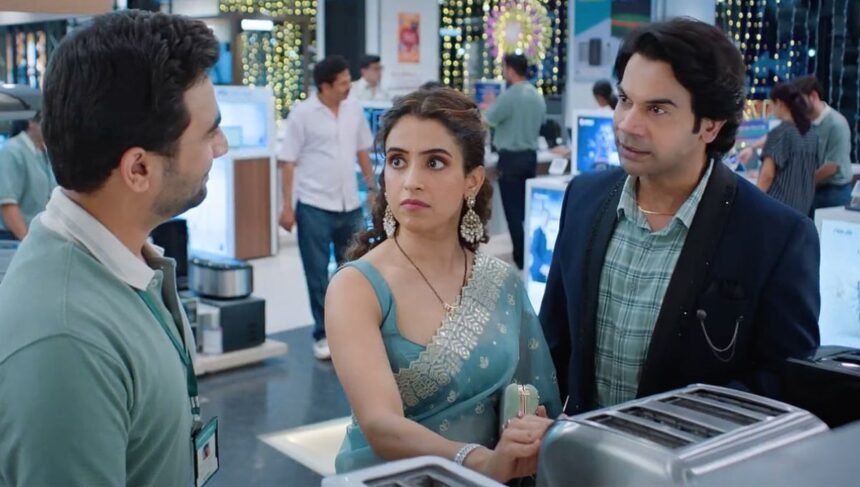
The story revolves around Ramakant, played by Rajkummar Rao, a man defined by his relentless obsession with saving money. Every decision he makes is shaped by thrift, and this defining trait becomes the engine that drives the plot forward. When he is persuaded to purchase an expensive toaster as a wedding gift, the decision sits uneasily with him from the start. His discomfort turns into determination when the wedding is abruptly called off, prompting him to retrieve the gift and reclaim his money at any cost.
What begins as a personal mission soon escalates into a chain of unpredictable events. The narrative stretches beyond domestic comedy, introducing darker undertones as Ramakant’s pursuit leads him into situations involving crime, secrets, and unintended consequences. At one point, the toaster itself becomes entangled in a larger controversy involving a politician, adding a layer of intrigue that pushes the film beyond its initial premise.
A mix of humour and crime elements
The film leans heavily on the idea of chaos born out of small decisions, using Ramakant’s frugality as both a comedic device and a narrative trigger. While this setup offers ample opportunities for humour, the storytelling repeatedly circles back to the same trait, limiting the scope for deeper exploration. The result is a film that starts with promise but struggles to build on its own foundation.
Performances stand out despite flaws
Rajkummar Rao carries the film
One aspect that consistently stands out across reviews is Rajkummar Rao’s performance. Known for portraying grounded, relatable characters, he brings energy and precision to Ramakant, making the character instantly recognisable and engaging. His comic timing and ability to navigate awkward situations lend the film much of its watchability, particularly in its early stages.
At the same time, there is a sense of familiarity in his performance that some critics have pointed out. While he remains effective, the character occasionally feels like an extension of roles he has played before, which limits the freshness of the portrayal as the narrative progresses.
Supporting cast offers mixed impact
Sanya Malhotra plays Shilpa, Ramakant’s wife, bringing a degree of restraint and warmth to the film. Her presence provides a counterbalance to Ramakant’s eccentricities, even though the script does not fully develop her character.
The supporting cast, including Archana Puran Singh and Abhishek Banerjee, adds moments of humour and unpredictability, but their roles often feel underwritten. While they contribute to individual scenes, they are not always woven seamlessly into the larger narrative, which affects the film’s cohesion.
Where the film struggles
Writing fails to sustain momentum
A recurring theme in any Toaster movie review is the film’s difficulty in sustaining its initial momentum. The central idea is strong, but the screenplay does not expand on it in a meaningful way. Instead, it returns repeatedly to the same comedic beat, stretching the humour thinner with each iteration.
As the film moves into its second half, this repetition becomes more pronounced. The pacing slows, the jokes begin to lose their edge, and the narrative starts to feel less like a progression and more like a series of loosely connected episodes. What could have evolved into a layered dark comedy instead remains confined to its original gag.
Tonal inconsistency affects storytelling
Another challenge lies in the film’s shifting tone. Toaster moves between comedy, crime, and absurd drama, but these transitions are not always smooth. Rather than complementing each other, the tonal shifts sometimes feel abrupt, creating a sense of disjointedness that disrupts the viewing experience.
There are flashes of sharp humour and clever writing scattered throughout the film, but they are too infrequent to anchor the narrative. The ambition to blend multiple genres is evident, yet the execution lacks the cohesion needed to make that blend effective.
A film of contrasts
Moments of humour amid inconsistency
Despite its flaws, Toaster is not without its moments. The early portions of the film, in particular, capture the absurdity of its premise with a certain ease, delivering humour that feels natural rather than forced. These moments hint at the film’s potential, suggesting a sharper, more focused version that might have been.
The Mumbai setting, which could have added texture and specificity to the story, remains largely in the background. As a result, the narrative loses an opportunity to ground its characters and situations in a more vivid and relatable environment.
Mixed critical reception
The response to Toaster reflects its uneven nature. Some reviews have described it as a fairly enjoyable and watchable comedy, driven by a strong central performance and an unusual premise. Others have been more critical, pointing to its lack of narrative depth and over-reliance on repetitive humour.
This divide underscores the film’s central tension: it has the ingredients of an engaging dark comedy but struggles to bring them together into a cohesive whole.
Final verdict
The broader Toaster movie review landscape makes it clear that the film is ultimately carried by its performances rather than its writing. Rajkummar Rao anchors the narrative with a performance that remains engaging even when the screenplay falters, but the film around him does not always rise to the same level.
For audiences, Toaster may still offer moments of entertainment, particularly if approached with modest expectations. However, for those looking for a tightly constructed dark comedy with consistent storytelling, the film is likely to feel like a missed opportunity rather than a fully realised success.